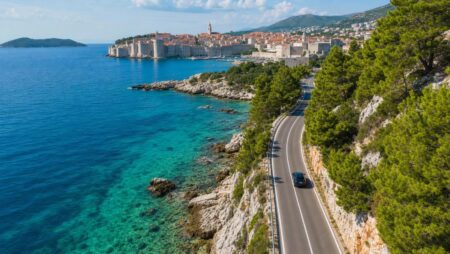


Cross border car hire Croatia needs a little more planning than a normal domestic rental. A road trip from Croatia can move between several countries in a single afternoon, but the selected supplier, vehicle category and rental agreement decide whether that route is actually permitted. Use the supplier information below as a starting point, then ask for the current written permission, documents, fees and insurance conditions for the countries you intend to enter.
This page is designed to answer the practical questions travellers ask before booking: which border permissions are needed, what to carry, how insurance and roadside assistance may work, whether a ferry or island leg is allowed, and how to compare the whole route rather than only the first daily rate. Requirements can change by supplier, date, vehicle and pickup point. A result in the booking engine is not, by itself, approval to leave the pickup country.
Tell the rental company every country that may appear on the itinerary, including a country you might cross only to reach another destination. Ask for the exact countries and border crossings to be recorded on the booking or authorisation. Confirm whether the fee is charged per rental, per country or per border, and whether the vehicle class is excluded. If the plan changes after collection, contact the supplier before crossing; do not assume a verbal conversation at the desk changes the contract.
Carry the driver’s passport or accepted travel document, the driving licence required for the journey, the rental agreement, the vehicle registration evidence and the insurance or cross-border authorisation supplied by the rental company. An international driving permit can depend on the driver’s nationality, licence format and destination, so check the current requirement for the actual trip rather than treating it as universal.
Some suppliers issue a Green Card or International Motor Insurance Card (IMIC), while others provide different evidence. That document can show insurance but does not replace the rental company’s permission. Keep the supplier emergency number available offline and save a digital copy of the agreement, but carry originals whenever an authority or supplier requires them. If there is an accident, follow the rental company’s reporting process and local authority requirements immediately; a private arrangement that bypasses the supplier can affect cover.
Travellers often compare Dubrovnik with Kotor, Split with Mostar, or Zagreb with Serbia and inland Bosnia. The short distance between destinations does not remove the need for written approval, insurance evidence and the exact crossing to be named on the rental agreement. Croatia’s coast can also involve ferries, old-town parking and seasonal queues, so leave room for the handover and return day.
For the first handover, compare Dubrovnik Airport car hire, Split Airport car hire or Zagreb Airport car hire with a city or port collection that fits the route.
Collecting at an airport is useful when the road begins straight after landing. City pickup can be calmer when the first nights are walkable and the car is only needed later. Port pickup adds a vessel timetable, a meeting-point question and sometimes a ferry or cruise transfer. Compare the pickup point with accommodation parking, arrival hours, luggage and the planned return, not simply the nearest pin on a map.
The headline comparison is only one part of the trip. Add the cross-border charge, deposit, excess, fuel policy, mileage, tolls, motorway vignettes, parking, ferry arrangements, child seats, additional drivers and any approved one-way movement to the same checklist. Ask how tolls are collected and whether an administration fee is added. Confirm when the deposit is released and which card must be presented by the named driver.
Ferries and islands deserve a separate question. Some agreements permit them, some require advance approval and some change the cover or recovery terms once the car leaves the mainland. Confirm whether the vehicle can board the intended ferry, how a delay is handled and who to call if the vehicle is damaged or immobilised away from the pickup country.
Before departure, make sure the countries and intended route are authorised in writing; the charge and insurance evidence are clear; the driver has the required documents; the selected vehicle is allowed; ferry, toll and fuel assumptions are understood; and the return point and opening hours are realistic. Recheck current border, embassy, road and travel advice immediately before leaving because official conditions and supplier policies can change.
For general European rental guidance, see the official Your Europe car-rental guidance. For local trip planning, visit the Croatia car-hire home page and read the local driving guide before you compare a vehicle.
Important: This is general travel-planning information, not legal, immigration or insurance advice. Confirm the current requirements with the selected supplier and the relevant official border, embassy, airport, road and travel authorities for every country on the itinerary. The supplier tabs below contain provider-specific rules and fees, which must also be reconfirmed at the time of booking.
Crossing the border is allowed into the following countries/areas:
EU.
For these countries, you will have to pay a Cross-Bordering Fee of EUR 50.00.
Cross-bordering into the following countries is also allowed:
Bosnia and Herzegovina, Montenegro, Russia, Serbia, UK.
However, you must pay a Cross-Bordering Fee of EUR 70.00.
Please note that not only international One-Way rentals qualify as cross-bordering – crossing the border into another country or state and back while returning the rental vehicle to the original pick-up location is also considered cross-bordering.
Cross border travel to Slovenia, Italy, Hungary, Serbia, Bosnia & Herzegovina, Montenegro, Macedonia and Kosovo are allowed and an additional charge of EUR 70 per rental will apply. All countries of travel must be noted at time of booking.
Travel on Ferry and/or to Island locations: A ferry insurance fee of EUR 30 per rental will apply for taking the rented vehicle on ferry and/or to Island locations. Pre-approval from the rental office is necessary.
Please check at the rental desk for more information.
Cross-bordering is only allowed by request.
Crossing the border is allowed into the following countries/areas:
Albania, Austria, Bosnia and Herzegovina, Germany, Hungary, Italy, Montenegro, Serbia, Slovenia.
You must pay a Cross-Bordering Fee of EUR 85.00.
Unauthorised cross-border driving is subject to a penalty fee of EUR 600.00.
All coverage becomes invalid if the rental vehicle is driven across a border without the Supplier’s authorisation.
Please note that not only international One-Way rentals qualify as cross-bordering – crossing the border into another country or state and back while returning the rental vehicle to the original pick-up location is also considered cross-bordering.
For travelling into Serbia, Kosovo, North Macedonia, Albania, Bulgaria, Romania, and Montenegro, purchasing of SCDW + WUG is mandatory at the rental desk.
Travel across borders is only permitted upon request and with prior written authorization from the supplier. Before the rental begins, customers must notify the rental desk that they plan to cross the border. The supplier will impose a penalty fee on you if you fail to comply.
A penalty of EUR 400 will apply if the rented vehicle is taken outside of Croatian borders without prior notice to the rental supplier.
Cross-border travel to EU and EEA countries, Bosnia and Herzegovina costs 90,00 EUR per rental.
Any driving outside the area is forbidden without written permission. In case of violation of this rule the Renter is fully responsible for all cost in case of damage of the vehicle; a fine of EUR 400 is applied.
In the event that Cross Border and Territorial Restrictions are violated, all protections lose their validity.
*EEA countries – Austria, Belgium, Bulgaria, Croatia, Cyprus, Czech Republic, Denmark, Estonia, Finland, France, Germany, Greece, Hungary, Ireland, Italy, Latvia, Lithuania, Luxembourg, Malta, Netherlands, Poland, Portugal, Romania, Slovakia, Slovenia, Spain, and Sweden. + 3 Non-EU EEA countries: Iceland, Liechtenstein, Norway.
*SCDW + WUG is available for a charge varying from EUR 26 to EUR 55 per day, depending on the vehicle group.
Cross-bordering is only allowed by request.
Crossing the border is only allowed into the following countries/areas:
Bosnia and Herzegovina, EU, Liechtenstein, Monaco, Montenegro, North Macedonia, San Marino, Serbia, Switzerland, the Vatican.
Cross-bordering into the following countries/territories is NOT allowed:
Albania, Armenia, Azerbaijan, Belarus, Estonia, Finland, Georgia, Greece, Kazakhstan, Kosovo, Kyrgyzstan, Latvia, Lithuania, Moldova, non-EU countries, Norway, Russia, Sweden, Tajikistan, Turkey, Turkmenistan, UK, Ukraine, Uzbekistan.
A Cross-Bordering Fee of EUR 85.00 per rental is applied.
Travel across borders is only permitted upon request and with prior written authorization from the supplier. Before the rental begins, customers must notify the rental desk that they plan to cross the border. The supplier will impose a penalty fee on you if you fail to comply.
Cross border travel within the European countries (including Switzerland and United Kingdom) is allowed and a cross border fee of EUR 40 (incl. VAT) will apply.
For Montenegro, Bosnia and Herzegovina, Albania, Serbia, North Macedonia and Kosovo and every non-EU country (excluding Switzerland and United Kingdom) a cross Border Fee of EUR 60 per rental (incl. VAT) applies.
In case of travelling through EU and non-EU countries (except Switzerland and United Kingdom) both charges of Cross Border Fee are applicable.
The green card covers the rented vehicle with basic insurance (T.P.I.) as long as it remains in the borders of the country for which it is issued.
Unauthorized cross-border travel will result in a breach of contract and incur a penalty charge.
Cross Border travel is allowed with prior written authorization from the rental desk (ask rental agent at the time of pickup).
Cross border rentals are allowed within the European countries.
Applicable fees for cross border travel are:
EU Countries – EUR 50 per rental
Bosnia and Herzegovina, Serbia, North Macedonia and Montenegro – EUR 80 per rental
Albania, Kosovo, Bulgaria and Romania – EUR 180 per rental
All charges above are inclusive of VAT
Travel to Turkey is NOT ALLOWED.
Travel across borders is only permitted upon request and with prior written authorization from the supplier. Before the rental begins, customers must notify the rental desk that they plan to cross the border. The supplier will impose a penalty fee on you if you fail to comply.
It is allowed to take the vehicle to the following countries for an additional charge of:
EUR 155 per rental – for Albania and Kosovo.
EUR 80 per rental – for Monaco, Switzerland and the rest of EU Countries.
EUR 125 per rental – for the rest to the Non-EU countries.
It is not allowed to take the vehicle to Romania, Bulgaria, Belarus, United Kingdom, Estonia, Lithuania, Ukraine, Russia, Turkey, Greece, Moldova, Finland, Sweden, Norway, Portugal, Armenia, Ireland, and North Macedonia.
In the event of an unauthorized border crossing, a penalty fee of EUR 350 will apply in addition to any other related costs.
In case of offense against Cross Border and Territorial Restrictions all insurances lose their validity.
Travel across borders is only permitted upon request and with prior written authorization from the supplier. Before the rental begins, customers must notify the rental desk that they plan to cross the border. The supplier will impose a penalty fee on you if you fail to comply.
It is allowed to travel to the countries of the region and most of the EU countries.
It is not allowed to travel to Kosovo, Ukraine, Russia, or Moldavia.
A mandatory fee of EUR 80 per rental will apply for driving outside the country to EU countries.
A mandatory fee of EUR 100 per rental will apply for driving outside the country to Non-EU countries.
For more information, please check with the office.
In case of offense against Cross Border and Territorial Restrictions all protections lose their validity.
If the vehicle was driven outside the border of Croatia without Carwiz premision and the purchase of a cross border fee, a penalty of EUR 500 will be applied.
Please check with the supplier at the rental desk for more details.
Cross-bordering is only allowed by request.
Crossing the border is NOT allowed into the following countries/areas:
Kosovo, Moldova, Russia, Ukraine.
You must pay a Cross-Bordering Fee of EUR 80.00–100.00.
Other cross-bordering restrictions and allowances may apply. Please enquire with the Supplier when picking up the vehicle.
Unauthorised cross-border driving is subject to a penalty fee of EUR 500.00.
All coverage becomes invalid if the rental vehicle is driven across a border without the Supplier’s authorisation.
Please note that not only international One-Way rentals qualify as cross-bordering – crossing the border into another country or state and back while returning the rental vehicle to the original pick-up location is also considered cross-bordering.
Cross border travel is allowed to Slovenia, Serbia and Montenegro, Bosnia/Herzegovina, Hungary and Western European Countries. For cross border travel arrangements are to be made with counter the at time of rental.
EUR 10 per day + tax up to a maximum charge of EUR 70 + tax per rental will be applicable as Green card/cross border fee will be applicable.
Cross border travel is not allowed to Kosovo, Turkey and Greece.
Travel across borders is only permitted upon request and with prior written authorization from the supplier. Before the rental begins, customers must notify the rental desk that they plan to cross the border. The supplier will impose a penalty fee on you if you fail to comply.
Cross border travel within the European countries (including Switzerland and United Kingdom) is allowed and a cross border fee of EUR 40 (incl. VAT) will apply.
For Montenegro, Bosnia and Herzegovina, Albania, Serbia, North Macedonia and Kosovo and every non-EU country (excluding Switzerland and United Kingdom) a cross Border Fee of EUR 60 per rental (incl. VAT) applies.
In case of travelling through EU and non-EU countries (except Switzerland and United Kingdom) both charges of Cross Border Fee are applicable.
The green card covers the rented vehicle with basic insurance (T.P.I.) as long as it remains in the borders of the country for which it is issued.
Unauthorized cross-border travel will result in a breach of contract and incur a penalty charge.
Crossing the border is only allowed into the following countries/areas:
Bosnia and Herzegovina, EU, Montenegro, North Macedonia, Serbia, Switzerland.
A Cross-Bordering Fee of EUR 112.50 per rental is applied.
Unauthorised cross-border driving is subject to a penalty fee of EUR 375.00.
Please note that not only international One-Way rentals qualify as cross-bordering – crossing the border into another country or state and back while returning the rental vehicle to the original pick-up location is also considered cross-bordering.
It is not allowed to cross NEUM Corridor Transit.
Cross border travel is allowed. A cross border fee of EUR 75 per rental will apply.
It is allowed to go to Bosnia and Herzegovina, Serbia and Montenegro.
Cross border travel to any other country is only on request.
Please check at the rental desk for more information.
A charge of EUR 21 + Tax per day with a maximum charge of EUR 42 + Tax per rental applies for driving the rented vehicle across any Croatian border with the exception of the Croatia – Bosnia & Herzegovina borders on the A8 main road (route E65) between Split and Dubrovnik, with the crossing allowance of maximum 2 hours in Bosnia & Herzegovina.
Further restrictions may apply. Please check with the supplier at the rental desk for more information
Cross border travel is not allowed into the following countries:
Albania, Armenia, Azerbaijan, Belarus, Estonia, Georgia, Ireland, Kyrgyzstan, Latvia, Lithuania, Moldova, Russia, Kosovo, Turkey, Ukraine, Any African country, Any Asian country, Any Middle East Country.
Failure to comply with these restrictions makes void all insurances in place and makes customers fully liable and responsible in case of thefts, accidents, damages to the vehicle and any resulting consequences.
If customer dropped the car in restricted country he will be charged for penalties from EUR 1000 to EUR 10000, but no less than for EUR 1000.
Cross border travel may be allowed into the following countries:
Andorra, Austria, Belgium, Bosnia & Herzegovina, Czech Republic, Bulgaria, Denmark, Finland, France,Germany, Greece, Hungary, Italy, Macedonia, Netherlands, Norway, Poland, Portugal, Romania, Serbia, Montenegro, Slovakia, Slovenia, Spain, Sweden, Switzerland and UK.
Crossing the border is allowed into the following countries/areas:
Albania, Bosnia and Herzegovina, EU, Hungary, Montenegro, Serbia, Slovenia.
For these countries, you will have to pay a Cross-Bordering Fee of EUR 95.00–125.00.
Cross-bordering into the following countries/territories is NOT allowed:
Armenia, Azerbaijan, Belarus, Estonia, Georgia, Greece, Iraq, Kazakhstan, Kosovo, Kyrgyzstan, Latvia, Lithuania, Moldova, North Macedonia, Romania, Russia, Tajikistan, Turkey, Turkmenistan, Ukraine, Uzbekistan.
You need written permission from the Supplier prior to departure in order to be allowed to drive the rental vehicle into another country. You can only request permission after you have signed the Rental Agreement with the Supplier when you go to pick up the vehicle.
Please note that not only international One-Way rentals qualify as cross-bordering – crossing the border into another country or state and back while returning the rental vehicle to the original pick-up location is also considered cross-bordering.
Crossing the border is allowed into the following countries/areas:
EU, Switzerland, UK.
For these countries, you will have to pay a Cross-Bordering Fee of EUR 40.00.
Cross-bordering into the following countries is also allowed:
Albania, Bosnia and Herzegovina, Kosovo, Montenegro, North Macedonia, Serbia.
However, you must pay a Cross-Bordering Fee of EUR 60.00.
You must have a Green Card.
You must notify the Supplier that you’re planning to drive the rental vehicle across the border when you pick up the vehicle.
Driving through the Neum Corridor is allowed without the Cross-Bordering Fee.
Please note that not only international One-Way rentals qualify as cross-bordering – crossing the border into another country or state and back while returning the rental vehicle to the original pick-up location is also considered cross-bordering.
Cross Border travel to Albania, Macedonia, Turkey, Greece, Bulgaria, Romania and Kosovo is allowed with prior written permission from the rental branch. A cross border fee of EUR 136 will apply.
Cross border travel is allowed to Austria, Belgium, Bosnia-Herzegovina (including Neum), Czech Republic, Denmark, Finland, France, Germany, Britain, Hungary, Ireland, Italy, Liechtenstein, Latvia, Luxembourg, Lithuania, Monaco, Montenegro, Holland, Norway, Portugal, San Marino, Serbia, Slovenia, Spain, Sweden, Switzerland and Vatican. An additional charge of EUR 56 + Tax will apply.
Please note that If borders are crossed without permission or paying the cross border fee, there will be a penalty of EUR 825 + Tax paid locally.
Cross border travel to Neum Corridor countries is allowed at no extra cost. Restrictions may apply.
Cross border travel is allowed to Non- EU countries with prior notification and a charge of EUR 57 (incl. VAT) per rental will be applicable.
Cross border travel is allowed.
A cross border fee of EUR 75 per rental will apply for travelling into Bosnia and Herzegovina, European Union and European Economic Area (EEA Countries), it includes all EU countries and also Iceland, Liechtenstein and Norway.
For travelling into Montenegro, Serbia, Albania, Kosovo and Macedonia, a cross border fee of EUR 75 per rental will apply plus it is mandatory to purchase Full insurance at the rental desk.
Ferry Travel is allowed only on request. A ferry travel fee of EUR 30 per rental will apply.
Please check at the rental desk for more information.
Cross-bordering into the following countries/territories is allowed:
Bosnia and Herzegovina, Hungary, Italy, Montenegro, Serbia, Slovenia.
However, you must purchase special insurance costing 69 HRK per day up to a maximum of 686 HRK per rental, with a minimum charge of 191 HRK per rental.
Cross-bordering is only allowed for rentals starting from limited locations.
If you plan to drive through the Neum Corridor, you must notify the Supplier when you pick up the rental vehicle and pay a fee of 95 HRK per rental.
Other cross-bordering restrictions and allowances may apply. Please enquire with the Supplier when picking up the vehicle.
Please note that not only international One-Way rentals qualify as cross-bordering – crossing the border into another country and back while returning the rental vehicle to the original pick-up location is also considered cross-bordering.
Cross-bordering is only allowed by request.
You must acquire special insurance (Green Card) costing EUR 90.00 per card.
Unauthorised cross-border driving is subject to a penalty fee of EUR 100.00 minimum.
All coverage becomes invalid if the rental vehicle is driven across a border without the Supplier’s authorisation.
Please note that not only international One-Way rentals qualify as cross-bordering – crossing the border into another country or state and back while returning the rental vehicle to the original pick-up location is also considered cross-bordering.
Cross Border Rentals are allowed to the following countries:
Andorra, Austria, Belgium, Bosnia and Herzegovina, Bulgaria, Czech Republic, Denmark, Finland, France, Germany, Great-Britain, Hungary, Ireland, Italy, Liechtenstein, Luxembourg, Monaco, Montenegro, Netherlands, Norway, Poland, Portugal, Romania, San Marino, Serbia, Slovenia, Slovakia, Spain, Sweden and Switzerland.
Vehicles passing through the Neum corridor are exempt from the foreign use charge.
For trips abroad, an additional fee of EUR 11.20 per day up to a maximum of EUR 56 per rental is charged. All trips abroad are to be requested t the local rental station.
In case of offence against Cross Border & Territorial Restrictions all protections lose their validity.
Cross-bordering is only allowed by request.
Crossing the border is only allowed into the following countries/areas:
Bosnia and Herzegovina, EU, Montenegro, North Macedonia, Serbia.
You must pay a Cross-Bordering Fee of EUR 70.00–350.00.
Unauthorised cross-border driving is subject to a penalty fee of EUR 500.00.
All coverage becomes invalid if the rental vehicle is driven across a border without the Supplier’s authorisation.
Please note that not only international One-Way rentals qualify as cross-bordering – crossing the border into another country or state and back while returning the rental vehicle to the original pick-up location is also considered cross-bordering.
aking rental vehicles on ferries is allowed. The fee for using a ferry is EUR 21.00.
A rental is considered One-Way if you return the vehicle to any location other than the one you picked it up from. Each quote is only valid for the selected pick-up and return locations. To see One-Way rates for other locations, please conduct a new online search or contact us directly.
Crossing the border is allowed into the following countries/areas:
Albania, Bulgaria, Greece, Kosovo, North Macedonia, Romania, Turkey.
For these countries, you will have to pay a Cross-Bordering Fee of EUR 136.00.
Cross-bordering into the following countries is also allowed:
Andorra, Austria, Belgium, Bosnia and Herzegovina, Czech Republic, Denmark, Finland, France, Germany, Gibraltar, Hungary, Ireland, Italy, Monaco, Montenegro, Netherlands, Norway, San Marino, Slovakia, Slovenia, Spain, Sweden, Switzerland, UK.
A Cross-Bordering Fee of EUR 56.00 per rental is applied.
Please note that not only international One-Way rentals qualify as cross-bordering – crossing the border into another country or state and back while returning the rental vehicle to the original pick-up location is also considered cross-bordering.
Travel across borders is only permitted upon request and with prior written authorization from the supplier. Before the rental begins, customers must notify the rental desk that they plan to cross the border. The supplier will impose a penalty fee on you if you fail to comply.
Vehicles are allowed to go to EU countries, Montenegro, Albania, Serbia, Bosnia and Herzegovina, Switzerland, North Macedonia and Norway.
Cross Border charges are EUR 69 (incl Tax) per rental.
Travel through the NEUM Corridor is subject to a charge of EUR 69 (Incl Tax). Cross border charges will apply at the rental desk.
Countries not listed are not permitted.
Please note that if you intend to travel internationally or from one state to the other there may be restrictions applicable.
In case of offence against Cross Border and Territorial Restrictions all protections lose their validity.
Cross-bordering is only allowed by request.
Crossing the border is allowed into the following countries/areas:
Bosnia and Herzegovina, Schengen Area.
For these countries, you will have to pay a Cross-Bordering Fee of EUR 56.00.
Cross-bordering into the following countries is also allowed:
Albania, Bulgaria, Kosovo, North Macedonia, Romania, Turkey.
However, you must pay a Cross-Bordering Fee of EUR 136.00.
You need written permission from the Supplier prior to departure in order to be allowed to drive the rental vehicle into another country.
Other cross-bordering restrictions and allowances may apply. Please enquire with the Supplier when picking up the vehicle.
Unauthorised cross-border driving is subject to a penalty fee of EUR 825.00.
Please note that not only international One-Way rentals qualify as cross-bordering – crossing the border into another country or state and back while returning the rental vehicle to the original pick-up location is also considered cross-bordering.
Taking rental vehicles on ferries is allowed. The fee for using a ferry is EUR 62.50.
Crossing the border is only allowed into the following countries/areas:
Austria, Bosnia and Herzegovina, Czech Republic, Germany, Hungary, Italy, Montenegro, Serbia, Slovakia, Slovenia, Switzerland.
A Cross-Bordering Fee of EUR 95.00 per rental is applied.
Unauthorised cross-border driving is subject to a penalty fee of EUR 300.00
Please note that not only international One-Way rentals qualify as cross-bordering – crossing the border into another country or state and back while returning the rental vehicle to the original pick-up location is also considered cross-bordering.