
Opatija Day Trips by Car: Best Routes from Croatia’s Grand Seaside Resort
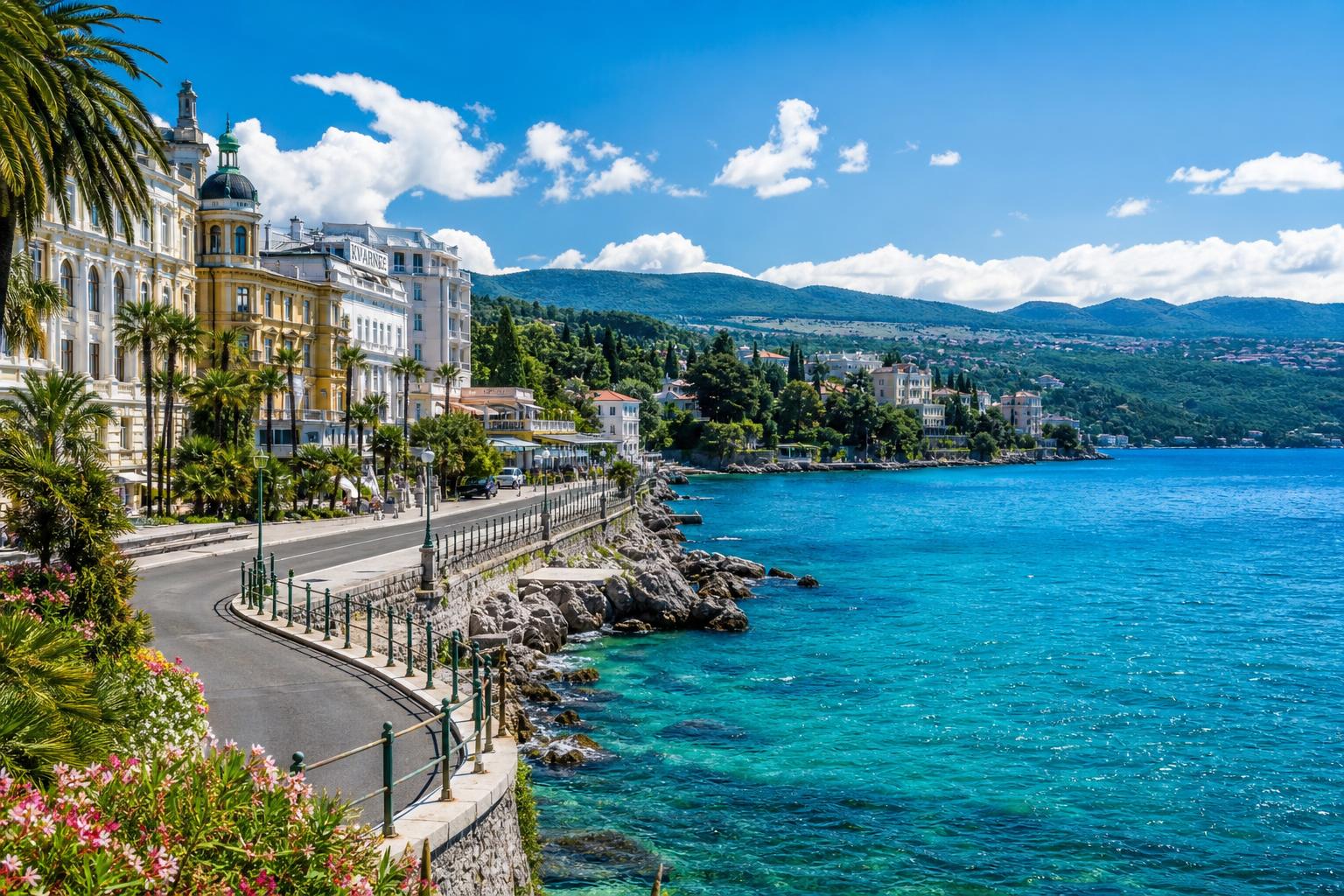
Opatija has been Croatia’s grand seaside resort since the Habsburgs built their villas along the Lungomare promenade in the late 1800s. The town itself is elegant, walkable and deliberately slow-paced. But the real reason to pick up a rental car in Opatija is what lies beyond the manicured gardens and belle époque facades. Within an hour’s drive you can reach Venetian hill towns, waterfalls, wine cellars and islands that most visitors never see. Here are the best day trips from Opatija by car, with honest driving times, parking advice and the stops that make each route worthwhile.
Why Use Opatija as a Road Trip Base?
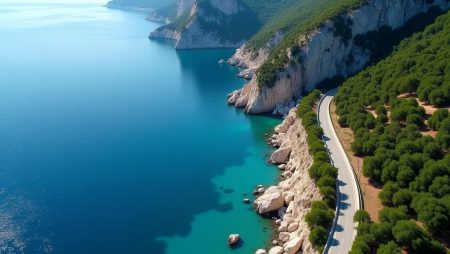
Opatija sits at a geographic sweet spot. To the north, the Istrian peninsula unfolds into a landscape of vineyards, truffle forests and medieval hill towns. To the south, the Velebit mountain range drops straight into the Adriatic, creating one of the most dramatic coastal roads in Europe. To the east, the inland motorway leads to Plitvice Lakes and Zagreb. And directly offshore, the Kvarner islands — Krk, Cres and Lošinj — are reachable by ferry from ports within a 30-minute drive.
Car hire in Opatija starts from around €18 per day in shoulder season and €28–35 in July and August. The town has paid parking along the waterfront, but most hotels offer guest parking. Once you have the keys, the whole region opens up.
Rovinj and the Istrian Coast (45 Minutes)
The drive from Opatija to Rovinj takes roughly 45 minutes on the D8 coastal road, then the A9 motorway toward Kanfanar. Rovinj is the most photographed town in Istria, and for good reason — the old centre rises from the sea on a steep peninsula, wrapped in pastel houses and crowned by the Baroque Church of St. Euphemia. It is also crowded from mid-morning onward in summer. The trick is to arrive before 9 am, walk the peninsula while the streets are still quiet, and have lunch in a konoba before the coach parties arrive.
Parking in Rovinj is straightforward. The large Valdibora car park sits just outside the old town gates and costs around €2 per hour in season. There is also street parking along the waterfront, but spaces fill quickly. After exploring Rovinj, drive 10 minutes south to the Lim Bay fjord, where oyster farms and family restaurants serve seafood pulled from the water that morning.
Pula and the Roman Amphitheatre (1 Hour)
Pula is Istria’s largest city and home to one of the best-preserved Roman amphitheatres outside Italy. The Arena dominates the waterfront and hosts summer concerts and film festivals. The drive from Opatija follows the A9 motorway south — roughly an hour in total. Unlike Rovinj, Pula spreads out and never feels overwhelmed by tourists. You can park in the large lot next to the amphitheatre, explore the Roman forum and the Temple of Augustus on foot, and still have time for coffee on the main square.
On the way back, take the inland road through Vodnjan and Bale. Both are quiet agricultural towns with narrow stone streets and almost no visitors. Bale in particular has a well-preserved medieval centre and a surprisingly good pizzeria in the main square.
Motovun and the Istrian Hill Towns (50 Minutes)
Motovun is the most famous of Istria’s hill towns, perched on a conical hill above the Mirna River valley. The drive from Opatija takes about 50 minutes via the A9 and then winding local roads. The town is small — you can walk the walls, visit the Romanesque church and buy truffle products in under two hours. Parking is at the base of the hill; a short, steep path leads up to the gate.
Grožnjan, 15 minutes north of Motovun, is less visited but equally atmospheric. It is an artists’ colony with galleries in every stone house and views across the valley toward Slovenia. The two towns pair well as a half-day loop. For lunch, stop at a truffle restaurant in Livade, the valley village below Motovun, where fresh pasta with shaved white truffle costs a fraction of what you would pay in Italy.
Plitvice Lakes National Park (2 Hours 30 Minutes)
Plitvice is a long day from Opatija — roughly two and a half hours each way via the A6 and A1 motorways — but it is doable if you leave early. The national park is Croatia’s most visited natural attraction: 16 terraced lakes connected by waterfalls and wooden boardwalks. The lower lakes near Entrance 1 are the most dramatic, with the Veliki Slap waterfall dropping 78 metres into a canyon.
Parking at Entrance 1 or Entrance 2 costs a few euros and fills by 9:30 in July and August. Buy tickets online in advance to skip the queue. The full walking route takes four to six hours, so bring water and comfortable shoes. If you want a shorter visit, take the electric boat across Kozjak Lake and walk the upper boardwalks for two hours before driving back. The return route via the A6 passes through Gorski Kotar, a forested mountain region where you can stop for dinner at a local lamb restaurant.
Rijeka and the Trsat Castle (20 Minutes)
Sometimes the best day trip is the shortest one. Rijeka, Croatia’s third-largest city, is only 20 minutes north of Opatija on the D8 coastal road. It is gritty, working-class and deliberately un-touristy — which is exactly why it is worth visiting. The Korzo pedestrian street runs through the Art Nouveau centre, the fish market on Dolac sells Adriatic sardines and squid straight from the boats, and the Trsat Castle overlooks the city from a hilltop above the Rječina canyon.
Park in the garage beneath Trsat or near the waterfront and explore on foot. Unlike Dubrovnik or Split, Rijeka does not perform for tourists. It is a real city with real cafes, real prices and a strong local identity forged by centuries as an Austro-Hungarian port. The contrast with polished Opatija is striking.
Krk Island and the Northern Kvarner (40 Minutes + Ferry)
Krk is connected to the mainland by a bridge from the village of Omišalj, about 40 minutes south of Opatija. The island is surprisingly large — 45 minutes from one end to the other — and varied. The town of Krk has a compact medieval centre and a busy marina. Vrbnik, perched on a cliff above the sea, is famous for Žlahtina, a dry white wine grown only on the island’s stony terraces. Baška, at the southern tip, has a 2-kilometre pebble beach backed by dramatic karst mountains.
From Krk you can also take the ferry from Valbiska to Cres and Lošinj, two islands that feel sleepier and less developed than the rest of the Croatian coast. The ferry takes 20 minutes and runs every few hours in summer. Having a car on Cres lets you reach Lubenice, a near-abandoned village on a cliff above a beach accessible only by steep path, and the griffon vulture colony near Beli.
The Lungomare Coastal Walk (No Driving Required)
Not every day trip needs a car. The Lungomare is a 12-kilometre coastal promenade that runs from Lovran, just north of Opatija, past Medveja and Mošćenička Draga to Brseč. The path follows the shoreline, passing through pine forest, rocky coves and small villages. You can walk one section, swim at a quiet beach, and return by local bus or taxi. But if you want to combine walking with driving, park at Medveja and walk north toward Lovran, or start at Mošćenička Draga and head south toward Brseč for the most dramatic cliffs.
Driving Tips for the Opatija Region
The D8 coastal road north of Opatija is scenic but narrow. Expect buses, cyclists and slow-moving local traffic. The A9 motorway is faster for reaching Istria but misses the coastal views. Tolls on the A9 are modest — a full crossing costs around €5.
In July and August, the Istrian coast from Poreč to Rovinj can be congested from mid-morning. Leave Opatija by 8 am for the smoothest journey. For Plitvice, a Tuesday or Wednesday visit sees fewer crowds than weekends.
Fuel is cheaper in Rijeka and Opatija than in the Istrian resort towns. Fill up before you cross into Istria if you are doing a long loop. Most stations accept cards, but carry some cash for rural petrol stations and toll booths.
FAQ
Do I need a car in Opatija?
For the town itself, no. Opatija is compact and walkable. But to explore Istria, the islands and the inland national parks, a rental car transforms a beach holiday into a proper road trip. Public buses run to Rijeka and some Istrian towns, but they are infrequent and do not reach the hill towns or remote coves.
How much does car hire cost in Opatija?
Economy cars start from around €18 per day in April, May, September and October. In July and August, expect €28–35 per day for a small car and €45–60 for a family vehicle. Book early for the best rates.
Can I take a rental car from Opatija to Slovenia or Italy?
Yes, but you must arrange cross-border permission with your rental supplier. Slovenia is straightforward — both are EU and Schengen members. Italy requires a vignette for Slovenian motorways if you cross via Trieste. Always confirm the insurance territory before you leave.
Is parking difficult in Opatija?
The waterfront has paid parking zones marked with blue lines. Rates are roughly €1–2 per hour in season. Most hotels include parking for guests. Street parking in residential areas further inland is often free but limited.
What is the best time of year for day trips from Opatija?
May, June, September and October offer the best balance of good weather, open roads and manageable crowds. July and August are hot and busy but still viable if you leave early. November to March is quiet, but some ferries and restaurants operate reduced hours.
Related Destinations
Planning your Croatian road trip? Also explore Rijeka car hire, Pula car hire, Rovinj car hire, Zadar car hire and our Rijeka Airport car hire guide for more route inspiration.
Ready to book? Visit our homepage for the best hire car deals.