
Discover Zagreb and its Surrounding Areas with Car Hire Zagreb
Why Zagreb Deserves More Than a Fly-Through
Too many travellers touch down at Franjo Tuđman Airport, grab a coffee at the arrivals hall, and bolt straight for the coast. They’re missing out. Zagreb is the kind of city that rewards a slower pace — cobbled streets that smell of fresh bread in the morning, tram lines that rattle past Austro-Hungarian façades, and a café culture so deeply ingrained that the local word for “hang out” literally translates to “coffee-ing.”
With car hire Zagreb from Cro Car Hire, you get the freedom to explore the capital on your own terms and then fan out into the countryside — Plitvice, Samobor, the wine roads of Plešivica — all within a day’s drive. No bus timetables, no tour-group herding, no compromise.
We operate out of Zagreb city centre and the airport, with a fleet that ranges from compact city runabouts (perfect for squeezing into a Gornji Grad parking spot) to comfy estates and SUVs for longer hauls. Pick up at our Zagreb location and the road is yours.
Zagreb City: Two Hills, Two Worlds
Zagreb splits neatly into two poles. Understanding this geography is half the battle — and it’ll shape where you park.
Gornji Grad (Upper Town)
This is the medieval heart. Park near Kamenita Vrata (the Stone Gate) and walk the rest. The gate itself is a tiny chapel wedged into the old city wall — even non-religious visitors stop to light a candle. Just beyond it, St. Mark’s Church hits you with that unmistakable tiled roof: the coat of arms of Zagreb on one side, the Triune Kingdom of Croatia on the other, all rendered in red, white, and blue ceramic.
The Lotrščak Tower fires a cannon every day at noon. It’s been doing this since 1877. If you’re anywhere in the Upper Town when it goes off, you’ll jump — consider yourself warned. Climb the tower for a panorama that stretches from Medvednica mountain to the Sava River.
The Museum of Broken Relationships is genuinely worth the €7 entry. It’s exactly what it sounds like: a collection of objects donated by people from around the world, each accompanied by a story of a relationship that ended. Some are heartbreaking, others darkly funny, and a few are profoundly weird. Give yourself an hour and a half.
When you need a break, Tkalčićeva Street is the obvious call. It’s the pedestrianised spine of the old town, lined with cafes and restaurants. Otto & Frank does a solid brunch — poached eggs, avocado, the works. For something more traditional, La Štruk serves nothing but štrukli, the baked cheese-and-dough dish that is essentially Zagreb’s edible mascot. Order the classic with sour cream. It’s about €6.
Donji Grad (Lower Town)
The Lower Town is the 19th-century grid, all grand boulevards and Secessionist architecture. The Green Horseshoe — a U-shaped chain of parks and squares — was laid out by city planner Milan Lenuci in the 1880s. Walk it end to end and you’ll pass the Croatian National Theatre, the Mimara Museum, and the Botanical Garden, which is free and quietly lovely in late spring.
Parking in Donji Grad is trickier. Use the public garage at Langov Trg (about €1.20 per hour) or the open-air lot behind the train station. Street parking in Zone 1 is metered and maxes out at 2–3 hours, so don’t push your luck — the “pauk” (tow truck) is legendary for its efficiency.
For coffee, head to Eli’s Caffè on Ilica — a local institution that’s been pulling shots since before espresso was cool in Zagreb. If you want to eat well without spending a fortune, try Curry Bowl in the courtyard at Varšavska 11. It’s Sri Lankan-run, absurdly good, and a main with a drink runs about €11.
Day Trip: Plitvice Lakes National Park
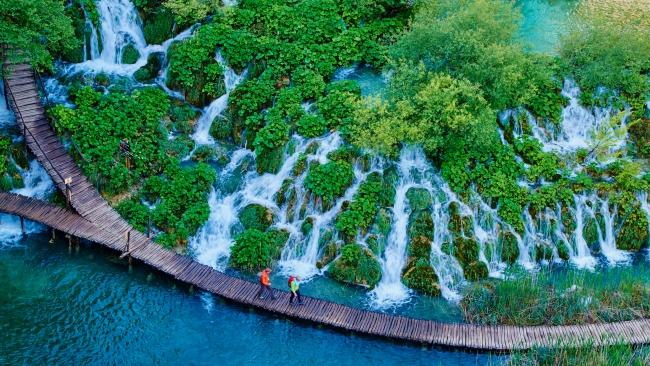
Plitvice is the heavyweight. Sixteen terraced lakes connected by waterfalls, suspended on a plateau between two mountain ranges, and boardwalks that take you inches above impossibly turquoise water. It’s a UNESCO site and Croatia’s most-visited inland attraction for good reason.
The drive from Zagreb takes about two hours on the A1 motorway (exit at Karlovac, then follow the signs). With your own car hire Zagreb, you can leave at 6:30 AM, arrive before the tour buses, and get two blissful hours on the boardwalks before the crush. Entry is €10–€40 depending on season (winter is cheapest, July/August peak). Book tickets online at least a day ahead — they cap daily visitors and sell out in summer.
The lower lakes (Donja Jezera) are the postcard shots: Veliki Slap, the 78-metre waterfall that’s the park’s tallest single drop. The upper lakes are quieter and more spread out. Do both if you’ve got the legs — the full circuit is about 8 km and takes 4–5 hours with photo stops.
Afterwards, drive 20 minutes to Rastoke, a village nicknamed “Little Plitvice.” Mill houses sit directly over waterfalls on the Slunjčica River. Restaurant Petro does freshwater trout pulled from the river that morning — grilled, with blitva (Swiss chard and potatoes) on the side, around €15.
Samobor: Cream Cakes and Cobblestones
Twenty-five minutes west of Zagreb, Samobor is the kind of town that Croatians gatekeep — they’ll tell you about Plitvice and the coast all day, but Samobor is where they go on a Saturday morning.
The main square (Trg Kralja Tomislava) is a pastel-coloured, perfectly proportioned rectangle lined with Baroque and Biedermeier townhouses. On one side, the 17th-century parish church of St. Anastasia; on the other, cafés with outdoor tables that fill up by 10 AM.
The thing to eat here is kremšnita — a Samobor-style custard slice with a puff-pastry top, a thick wedge of vanilla custard, and a drift of powdered sugar. U prolazu café, right on the square, has been serving them since the 1920s. One slice is about €3.50. Order it with a Turkish coffee and don’t plan anything strenuous for the next hour.
Walk off the sugar on the trail up to Stari Grad, the ruined 13th-century castle on the hill above town. It’s a 20-minute climb and the view over Samobor and the Žumberak hills is worth the sweat. On the way back down, stop at Samoborska Pivovara, a microbrewery in a converted cinema. Their unfiltered lager is excellent, and a half-litre runs about €3.80.
For a proper meal, Gabreku 1929 is a 10-minute drive into the hills above town. It’s a family-run konoba (tavern) that’s been serving the same recipes for nearly a century. The lamb peka — slow-cooked under a metal bell covered in embers — needs to be ordered a day in advance. Call ahead. If you haven’t planned that far, the češnjovke (garlic sausages) are a very solid consolation prize.
The Plešivica Wine Road
Thirty kilometres west of Zagreb, the Plešivica hills are Croatia’s answer to Champagne country — same latitude, similar limestone soils, and a sparkling wine tradition that dates back to the 19th century. The road winds through villages with names like Jastrebarsko and Donja Reka, past vineyard slopes planted with Graševina, Chardonnay, and Pinot Noir.
Start at the Korak winery. The family has been making wine here since 1945, and their tasting room sits on a ridge with a view that stretches to the Slovenian border on a clear day. A tasting flight of five wines runs about €12. Their sparkling rosé is the standout — bone-dry, fine mousse, all wild strawberries and brioche.
Next stop: Tomac, about 15 minutes further up the road. Tomac is famous among natural-wine geeks for their amphora-aged Graševina — fermented in clay qvevri buried in the cellar floor, unfiltered, a little funky, and completely unlike anything else in Croatia. The tasting room is small and you’ll want to book. Tastings are €15–20 depending on the lineup.
For lunch, the Jagunić wine cellar in Plešivica village does a set menu with paired wines: three courses, five wines, around €35 per person. It’s a family affair — the son pours the wines while the mother cooks. The roast veal with mlinci (a kind of pasta baked in meat juices) is the dish to hope for.
Driving back to Zagreb takes about 40 minutes. If you’ve been tasting generously, remember Croatia has a 0.05% blood alcohol limit — stricter than the UK and on par with most of the EU. Designate a driver or book a local taxi.
Practical Tips for Car Hire in Zagreb
Zagreb’s road network is straightforward once you’re out of the centre. The A1 motorway (tolled) runs southwest toward Karlovac and eventually the coast; the A3 bypass rings the city to the south and connects east-west. Tolls are paid in kuna-equivalent euro at booths — keep some cash or a contactless card handy.
Winter driving (November–March) means snow tyres are mandatory by law. All car hire Zagreb vehicles in the Cro Car Hire fleet come with the correct seasonal equipment — just confirm at pickup.
Fuel is widely available. INA and Crodux are the main chains. Expect to pay around €1.45–1.55 per litre for unleaded, slightly less for diesel. Stations along the A1 are open 24/7.
From Zagreb, the rest of Croatia is well within reach. The drive to Split on the A1 takes about four hours. Dubrovnik is further — roughly six hours via the A1 and the Pelješac Bridge, but the scenery along the way makes it feel like a highlight rather than a slog. Book your car hire Zagreb with Cro Car Hire and start your journey in the capital before heading south.