
Split to Trogir Drive | From €18/day | Car Hire Croatia
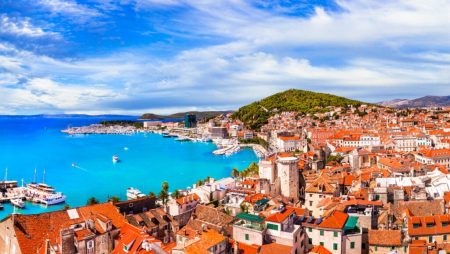
Split to Trogir is one of the shortest and most satisfying drives in Dalmatia — just 30 kilometres along the coast, taking about 25 minutes on the main road. You are going from one UNESCO World Heritage city to another, and the road between them passes through a string of small towns that have been inhabited continuously since Roman times.
Most people make this as a day trip from Split, which is exactly the right call. Trogir’s old city is compact enough to explore in a few hours, and you are back in Split well before dinner. But if you have more time, spending a night in Trogir is worth it — the city empties of day-trippers by 6 PM and the waterfront comes alive.
The Route: Two Options
There are two ways to drive from Split to Trogir. The faster option takes the coastal route through the Kaštela towns. The scenic option adds about 10 minutes and stays closer to the sea. Both are well-signposted.
Route 1: Via the D8 Coastal Road (Scenic, ~35 min)
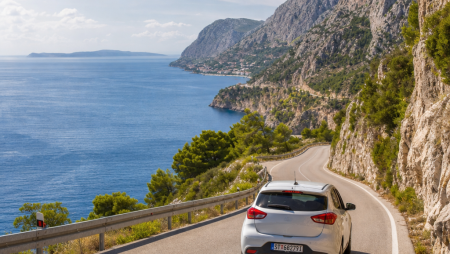
The D8 is the old Adriatic Highway — the coastal road that runs the full length of the Dalmatian coast. From Split’s city centre you head east along the Riva waterfront, then north-east past the Firule beach area and the stadium. The road passes through the suburb of Kamen, then descends into the first of the Kaštela towns: Kaštel Sućurac.
The Kaštela Riviera is a 20-kilometre stretch of coast between Split and Trogir, made up of seven small towns that grew up around individual castle towers built by local noble families in the 15th and 16th centuries to defend against Ottoman raids. You pass through each one — Kaštel Sućurac, Kaštel Lukšić, Kaštel Kambelovac, Kaštel Gomilica, Kaštel Novi — and you can see the towers from the road, rising above the modern buildings.
The road is two lanes with plenty of passing opportunities. Traffic is light early morning and late afternoon; it fills up between 9 AM and 3 PM in summer. The sea is visible on your right for most of the drive. About 5 kilometres before Trogir, you pass through the town of Okrug Gornji, known for its beach on Čiovo island (connected to the mainland by a small bridge) and its evening market in summer.
Route 2: Via the A1 Motorway (Fastest, ~25 min)
The A1 toll motorway from Zagreb to Dubrovnik has an interchange at Dugopolje, about 15 kilometres inland from Split. If you are coming from Split centre, you head north out of the city on the D1 towards Dugopolje, pick up the A1 eastbound, and come off at the Vrpolje exit — which puts you directly onto the D8 about 5 kilometres west of Trogir.
The motorway is the faster option and it is toll-based (about €2-€3 for this section). The D1 approach from Split is a good dual-carriageway road through the hinterland. This route is the better choice if you are combining Split to Trogir with a visit to the Krka waterfalls or Šibenik — you skip the coastal towns entirely and come at Trogir from the landward side.
What You See Along the Way
Kaštel Sućurac (km 8): The first and oldest of the Kaštela towns. The castle tower, Kaštilac, sits on a hill above the town — you can see it from the road on your right as you enter. It is not open to the public but makes a good photo stop if you want to pull over.
The Kaštela olive groves (km 12-18): Between Kaštel Lukšić and Kaštel Novi, the road passes through an area of old olive groves and vineyards. The local olive oil — extra virgin, slightly peppery — is sold in small quantities at the roadside. If you see someone with a table set up near the road selling bottles, it is worth stopping. A 500ml bottle of genuine Dalmatian olive oil costs €8-€15 depending on the producer.
Okrug Gornji beach (km 24): Just before the causeway to Čiovo island. The main beach here is a long stretch of pebbles and concrete platforms with shallow water — popular with families. In peak summer (July-August), it fills up by mid-morning. Park on the inland side of the road — there is a large public car park near the beach entrance — and walk across to the seafront.
Arriving in Trogir: Parking
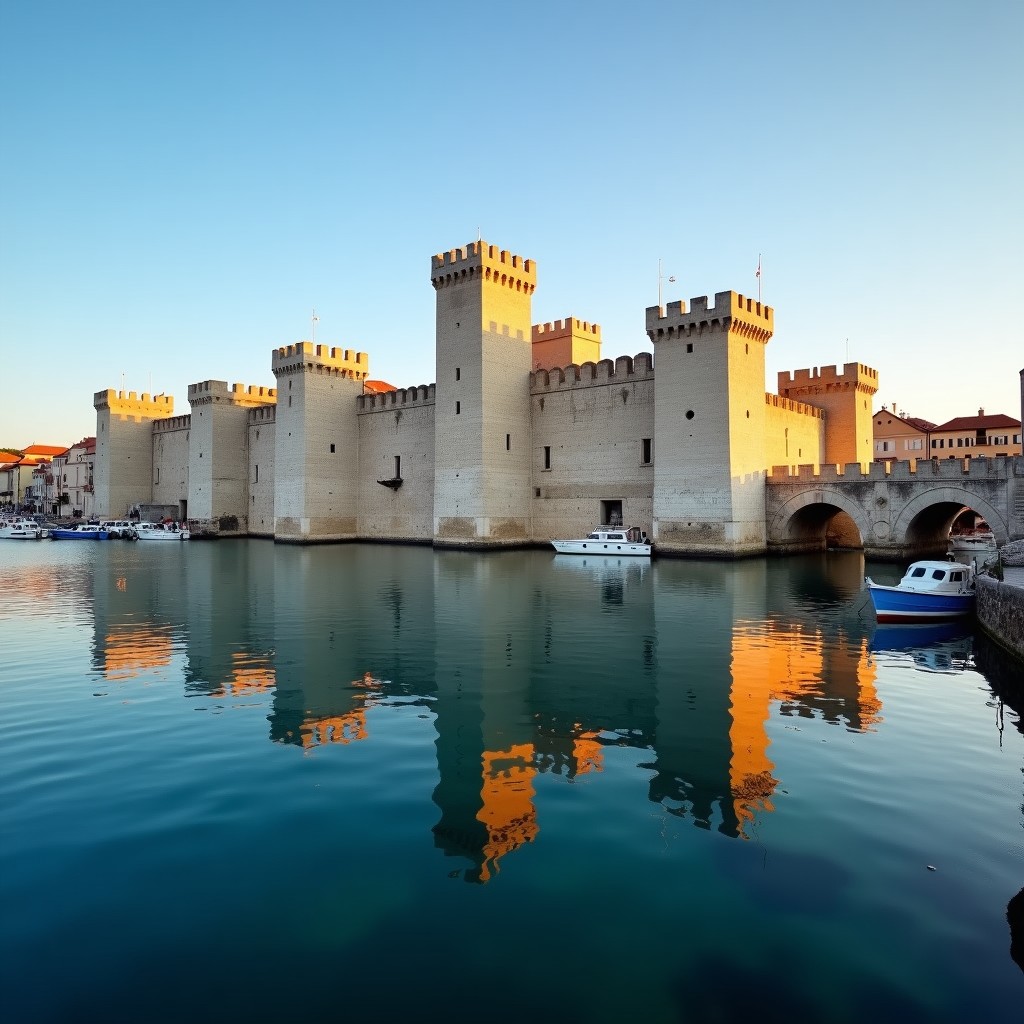
This is the one practical frustration of visiting Trogir by car. The old city is on a small island connected to the mainland by two small bridges, and there is no parking on the island itself.
Your options:
Public car park (P3 — Cibleh): The main public car park is on the mainland side, a 5-minute walk from the old city bridge. In summer it fills by 10 AM. Current rate is approximately €1.50-€2 per hour, €10-€15 per day depending on season. This is your best bet if you are visiting for the day.
Street parking on the mainland: There are some metered spots along the waterfront road (Obala Fonda) near the tourist information office. Cheaper than the car park but fills very fast in summer. Time limit is typically 2-3 hours.
Čiovo island: The eastern side of Čiovo (the island you cross to reach Okrug Gornji) has several informal parking areas near the beach. From there you can walk or take a small ferry across the channel to Trogir’s western side. This is the best option if you are planning to spend the day at the beach before visiting Trogir in the late afternoon.
What to Do in Trogir
Trogir’s old city is one of the best-preserved Romanesque-Gothic towns in Europe, and it is remarkably compact — you can walk the full length of the old city in about 10 minutes. The main sights are all within the city walls.
Trogir Cathedral (St. Lawrence Cathedral): The cathedral’s main entrance is through the Romanesque portal, carved in 1240 by local master Raduan. The lintel shows Adam and Eve, theLabours of the Months, and the signs of the Zodiac — one of the finest examples of Romanesque sculpture in Dalmatia. The bell tower is climbable (120 steps) and gives you a 360-degree view over the old city, the harbour, and the coast. Admission is about €4-€5 for the cathedral and tower combined.
The loggia and clock tower: In the main square (Trg sv. Lovre), the 15th-century loggia was used as the town’s public meeting place and market hall. Next to it, the clock tower has a notable zodiac carved on its face.
The Çingene bridge: This footbridge connects the old city to the mainland. It was built in the 18th century to replace an earlier drawbridge. The view from the bridge back toward the old city’s western wall and the cathedral tower is the classic Trogir photograph.
Markets: There is a small morning market (fish, fruit, vegetables, local cheese) on the waterfront most mornings until about 1 PM. On Saturdays there is a larger market on the mainland side selling household goods, plants, and local produce.
The Best Time to Drive
Summer (July-August): The D8 coastal road is busy with local traffic between 9 AM and 3 PM. The coastal towns fill up with day-trippers and the car parks fill early. If you are visiting Trogir in summer, arrive before 9 AM or after 4 PM — the city is genuinely lovely in the late afternoon when the tour groups have gone, and dinner on the waterfront as the sun goes down is the best experience of the place.
Shoulder season (May-June, September-October): This is the ideal time. The roads are quiet, parking is manageable, and Trogir is at its most atmospheric — warm days, cool evenings, the city to yourself before and after the cruise ship day-trippers arrive (cruise ships typically anchor in the harbour from 8 AM, with passengers in the old city by 9-10 AM).
Winter: Trogir in winter is a different place — many restaurants and shops close, the waterfront is quiet, and the city has a meditative quality. The drive is straightforward in any weather, though the coastal road can be damp in November-February. The A1 motorway route is the better option in heavy rain.
Driving Costs: Split to Trogir
When you book through crocarhire.com, you compare all major suppliers side by side with full cost transparency — no hidden fees, no surprise surcharges at the counter. The prices you see include all mandatory taxes and charges.
Fuel: The 30-kilometre coastal route uses approximately 3-4 litres in a compact rental. At current Croatian fuel prices (around €1.55 per litre for diesel), that is about €5-€7 for the round trip. If you take the motorway route, add €4-€6 in tolls (A1 Dugopolje-Vrpolje section plus the D1 approach from Split).
Parking: Approximately €10-€15 for a full day in the public car park during summer. Shoulder season and winter rates are typically lower.
Total estimated round-trip cost: €15-€25 including fuel and parking, depending on route and season. No vignette required for either route — Croatia’s motorway vignette system applies to longer journeys on the A1/A2, not the Dugopolje interchange used on this trip.
Crossing to Čiovo Island
If you have more time, the small island of Čiovo — connected to the mainland by a bridge at Okrug Gornji and to Trogir’s western side by a pedestrian drawbridge — is worth crossing. The island’s eastern side has several good swimming spots: the beach at Okrug Gornji, the coves around Slatine on the north side, and the pine-shaded swim platform near the tiny harbour of Groh. Čiovo is flat and cycle-friendly — you can hire bikes in Okrug Gornji in summer.
Can You Visit Trogir Without a Car?
Yes, and many people do. There is a regular bus service (Line 37) from Split’s main bus station to Trogir that takes about 50 minutes and runs every hour or so. The bus drops you at the Trogir mainland bus stop, a 5-minute walk from the old city bridge. Taxis from Split to Trogir cost about €30-€40 one way. The drive is more flexible than either of these options, particularly if you want to stop at the Kaštela towns or combine Trogir with the Krka waterfalls or Šibenik on the same day.
Summary
The Split to Trogir drive is 30 kilometres of Dalmatian coast in 25-35 minutes, from one UNESCO old city to another. Take the coastal D8 if you want the scenic route through the Kaštela towns and the sea views. Take the A1 motorway if you are combining Trogir with Krka or Šibenik. Arrive early or late in summer to avoid the day-tripper crowds, and plan to eat dinner on the waterfront — Trogir at dusk, after the tour groups have left, is the version worth seeing.
Related Destinations
Looking for other driving routes from Split? Also explore the Split to Zadar coastal drive, the Dubrovnik to Kotor Montenegro border crossing, and the Zagreb to Plitvice Lakes route. Compare all major suppliers and lock in a competitive rate with car hire in Split.
Ready to book? Visit our homepage for the best hire car deals.