
Zagreb to Dubrovnik Drive | From €18/day | Cro Car Hire
Driving from Zagreb to Dubrovnik is the great Croatian road trip — 610 kilometres that take you from the Austro-Hungarian Habsburg elegance of the capital, across the karst plateau of Lika, and down to the sun-baked stone walls of the Adriatic’s most famous city. You can do it in a day (allow 5h45 to 6h30 with rest stops), or better, break it overnight in somewhere like Zadar or Split and make it a proper journey.
There are two viable routes — the faster A-1 motorway via Zadar and Split, or the longer coastal D-8 road through Omiš and Makarska. Each gives you a completely different country. Here’s what you need to know before you set off.
Route 1: A-1 Motorway (Faster, 6h–6h30)
The A-1 is Croatia’s main north-south highway and the fastest way from Zagreb to Dubrovnik. From the capital’s harbour interchange, you head south on the A-1 and stay on it almost all the way — it runs past Karlovac, then cuts through the Lika region (this is the karst plateau that makes up much of inland Dalmatia), past Gospić, then descends toward Zadar and the Dalmatian coast.
The toll cost is the main consideration. Zagreb to Dubrovnik on the A-1 costs roughly €48 to €55 in tolls depending on your vehicle class. The toll system uses a combination of open and closed toll booths — you take a ticket at the start and pay at the end (or at major toll plazas along the way). Credit cards are accepted at most booths. The journey from Zagreb to the Dalmatian coast (Zadar exit) is about 3 hours, then it’s another 3 hours down the coastal motorway to Dubrovnik.
You need a vignette to use Croatia’s motorways. Short-term vignettes (weekly, monthly) are available at border crossings and service stations. The weekly vignette for Croatia costs about €15 for a car — it’s required on all A-1 sections.
Route 2: D-8 Coastal Road (Scenic, 8–9 hours)
The D-8 is the old coastal road that runs the full Dalmatian coastline from Rijeka to Dubrovnik. It’s slower — seriously slower in summer, when single-lane sections and small towns create kilometres of queue — but it’s one of the most spectacular coastal drives in Europe. If you have two days and want to see the real Dalmatian coast, this is the route.
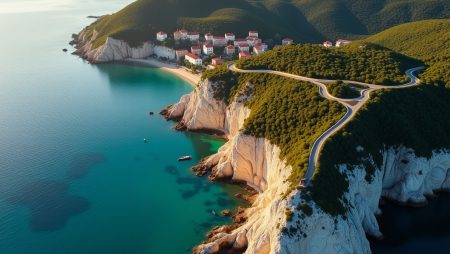
The D-8 runs through Omiš (with its canyon just south of town), Makarska (longer beach stops), and then the Rivieran settlements toward Ploče. North of Omiš, the road climbs over the Omiška Djela mountains on a series of switchbacks with incredible views back over the coast. The road is mostly single lane with passing places, and summer weekends can see it crawling with campervans.
No vignette is needed for the D-8 — it’s a national road, not a motorway. Fuel is your main cost, and the coastal detours add roughly 80 kilometres compared to the motorway route.
Zagreb to Dubrovnik via Plitvice Detour
If you haven’t been to Plitvice Lakes, the detour from the A-1 is worth knowing about. The turn-off to Plitvice is at Karlovac — you take the D-1 northeast toward Slunj, which puts you at Plitvice’s Entrance 1 in about 2 hours from Zagreb. From Plitvice back to the A-1, you rejoin at the same Karlovac junction.
This adds roughly 90 kilometres and 1h30 to 2 hours to the total trip, so it’s really only viable as an overnight stop or if you’re starting very early from Zagreb. But Plitvice in the morning, before the tour buses arrive around 10 AM, is a completely different experience to visiting in the afternoon.
What This Drive Actually Costs
Fuel: Expect 55-65 litres for the 610-kilometre trip in a standard rental. At Croatia’s current fuel prices (around €1.55 per litre for unleaded), that’s roughly €85-€100 for the round trip — less if you’re doing it one-way and just filling before drop-off.
Tolls (A-1 route): Approximately €48-€55 one-way for a standard car. You can pay in cash (kuna or euros) or card at toll booths.
Vignette: If you don’t already have a Croatian vignette from entering the country, the weekly vignette is about €15. Available at petrol stations approaching the motorway.
Total estimated cost (one-way, A-1): Approximately €150-€165 for fuel, tolls, and vignette for a standard compact rental.
Driving Conditions by Season
Summer (June–August): The A-1 is busy on Friday afternoons and Sunday evenings as Croatians head to the coast or back to Zagreb. The D-8 coastal road is severely congested on summer weekends — avoid it if you’re in a hurry. Early morning departures (before 7 AM) make a massive difference on either route in peak season.
Shoulder (May, September, October): The sweet spot. The A-1 is calm, the D-8 coastal road is quiet enough to actually enjoy, and the weather is perfect for both driving and sightseeing. September is particularly good — the sea is still warm enough to swim at Dubrovnik’s beaches, the coastal road has almost no traffic, and the mountain sections of the A-1 have that crisp autumn light.
Winter (November–March): The A-1 operates normally but can see snow on the Lika section in heavy winters — the road passes through a karst plateau at altitude. The D-8 coastal road is generally fine in winter but can be closed briefly during heavy rain or snow events. This is the quietest time to make the drive but also the coldest, and some coastal towns along the D-8 are effectively shut down.
Where to Stop Along the Route
Zadar (A-1 exit or D-8 pass-through): Allow 2-3 hours. The old town is walkable and distinctive — the Sea Organ and Sun Salutation art installations on the waterfront are worth the stop alone. Roman forum ruins sit in the town centre. Good lunch options near the port.
Šibenik (detour from A-1, 30 min each way): The Cathedral of St. James is a UNESCO World Heritage site and one of Croatia’s most impressive pieces of architecture. Also worth a stop for the walks around the old town’s narrow streets.
Split (A-1 exit or D-8 pass-through): Allow 3-4 hours minimum. Diocletian’s Palace is the heart of the city — it’s not a museum, it’s a living neighbourhood built inside a Roman emperor’s retirement palace. Walk the substructures, climb the bell tower for a city view, and eat at the KonobaMatejuška in the harbour for solid Dalmatian food without the tourist premium.
Omiš (D-8 only): A small town at the mouth of the Cetina River canyon. The canyon is spectacular — you can see it from the road as you descend, or stop at one of the river beaches south of town. Good for a lunch stop if you’re on the coastal route.
Car Hire Considerations for This Trip
If you’re doing the one-way Zagreb-to-Dubrovnik drive, most rental companies charge a one-way fee for this route — typically €30 to €80 depending on the company and vehicle class. It’s always worth asking about drop-off in Dubrovnik when you pick up in Zagreb. Some companies offer this free if you book it as a package; others charge as a surcharge.
Confirm your rental includes cross-region travel within Croatia — virtually all do, but some budget policies restrict travel to certain zones. Also confirm whether your policy covers the coastal roads (D-8) — most do, but check the fine print for unpaved or rough-surface exclusions.
Summary
The Zagreb to Dubrovnik drive is a journey across two different Croatians — the Habsburg continental north and the Mediterranean Dalmatian south. The A-1 motorway gets you there fastest; the D-8 coastal road gets you there with better stories. Either way, break it somewhere. Split makes the most sense as a halfway point, with Zadar as a compact alternative. Start early, budget for tolls on the motorway route, and don’t skip the detour to Šibenik if you have the time.
Ready to book? Visit our homepage for the best hire car deals.