
Rent a Car in Croatia: First-Time Booking Guide & What to Expect
Rent a Car in Croatia: First-Time Booking Guide & What to Expect
Hiring a car in Croatia for the first time? It is simpler than you might think, but a few local quirks can catch visitors off guard. Whether you are landing at Split Airport, Dubrovnik Airport, or picking up in Zagreb, this guide covers everything you need to know before you book, from paperwork to pickup and the first kilometres on Croatian roads.
Do You Need a Car in Croatia?
Croatia is built for driving. The Dalmatian Coast stretches over 1,700 kilometres of shoreline, island ferry connections are frequent but seasonal, and inland national parks like Plitvice Lakes and Krka are far easier to reach with your own wheels. Public buses connect the major cities, but if you want to stop at a beach cove you spotted from the road, explore Istrian hilltop villages, or drive the coastal road from Split to Dubrovnik at your own pace, a rental car is the way to go.
That said, Dubrovnik Old Town and Split’s historic centre are pedestrian-only zones. Parking in both cities is limited and pricey in peak season. The smart move is to hire a car for the days you are exploring the coast and islands, and use local buses or walk when you are in the city centres.
What You Need to Book
The requirements are straightforward. You will need:
- A full valid driving licence held for at least one year (two years for some premium categories)
- A credit card in the main driver’s name for the security deposit
- A passport or national ID (non-EU visitors need a passport)
- To be at least 21 years old — some suppliers require 23 or 25 for larger vehicles
UK and EU licences are accepted without issue. If your licence is not in the Roman alphabet (for example, Arabic, Cyrillic, or Chinese), you will need an International Driving Permit (IDP). This is not a suggestion — it is checked at the rental desk.
Understanding the Costs
Daily rates in Croatia vary dramatically by season. In January, a compact car in Zagreb can cost as little as €8 per day. In July, the same car in Dubrovnik can jump to €40–€60 per day. Booking early is the single best way to keep costs down.
Here is what you are actually paying for:
- Base rental rate — the headline price you see when you search
- Collision Damage Waiver (CDW) — included by default, but usually comes with an excess of €500–€1,500
- Theft protection — standard on most rentals
- Third-party liability — mandatory and included
- Airport surcharge — typically €15–€25 if you pick up at an airport
- One-way fee — only applies if you drop off in a different city (€30–€80)
- Young driver surcharge — usually €10–€15 per day for drivers under 25
- Additional driver — €5–€10 per day
- Child seat / GPS — €5–€10 per day each
The extras add up. Always compare the total price, not just the base rate. Look for bookings that include a full-to-full fuel policy — you pick up with a full tank and return it full. This is the fairest deal. Avoid pre-purchase fuel options unless you are certain you will use every drop.
Manual vs Automatic
Most rental fleets in Croatia are manual transmission. Automatics are available but cost 30–50% more and book out fast in summer. If you need an automatic, book as early as possible. Do not assume you can upgrade at the desk in July — the automatics are usually gone by May.
Insurance: What You Actually Need
The base CDW covers damage to the rental car, but you pay the excess first. You have two options to reduce or remove that excess:
- Buy the rental company’s excess waiver at the desk — typically €10–€20 per day. Convenient but expensive.
- Use a standalone excess reimbursement policy from a third-party insurer before you travel — often €2–€5 per day. You pay the excess to the rental company if damage occurs, then claim it back.
One thing to know: if you decline the rental company’s excess waiver, they will place a hold on your credit card for the full excess amount (up to €1,500). Make sure your card has available credit.
Tyres, wheels, and windscreens are often excluded from standard CDW. If you are driving narrow coastal roads or mountain passes, consider adding coverage for these.
Pickup Day: What to Check
When you collect the car, take photos or a video of every panel, the wheels, and the interior. Note any scratches or dents on the check-out form before you sign. This takes two minutes and can save you hours of dispute later.
Check the fuel gauge and confirm the policy. Ask where the nearest petrol station is for your return — airports usually have one within a few kilometres, but it helps to know in advance.
Verify the emergency number for the rental company. Save it in your phone. Croatia’s motorway breakdown service is HAK (Hrvatski Autoklub) on 1987, and the general emergency number is 112.
Driving in Croatia: The Basics
Croatia drives on the right, overtakes on the left. Speed limits are:
- Motorways (autoceste): 130 km/h
- Main roads: 90 km/h
- Built-up areas: 50 km/h
Motorways use electronic tolls. You collect a ticket at entry and pay at exit — cash or card. The main coastal motorway, the A1, runs from Zagreb to Split to Ploče. It is fast, well-maintained, and scenic. The toll from Zagreb to Split is about €18.
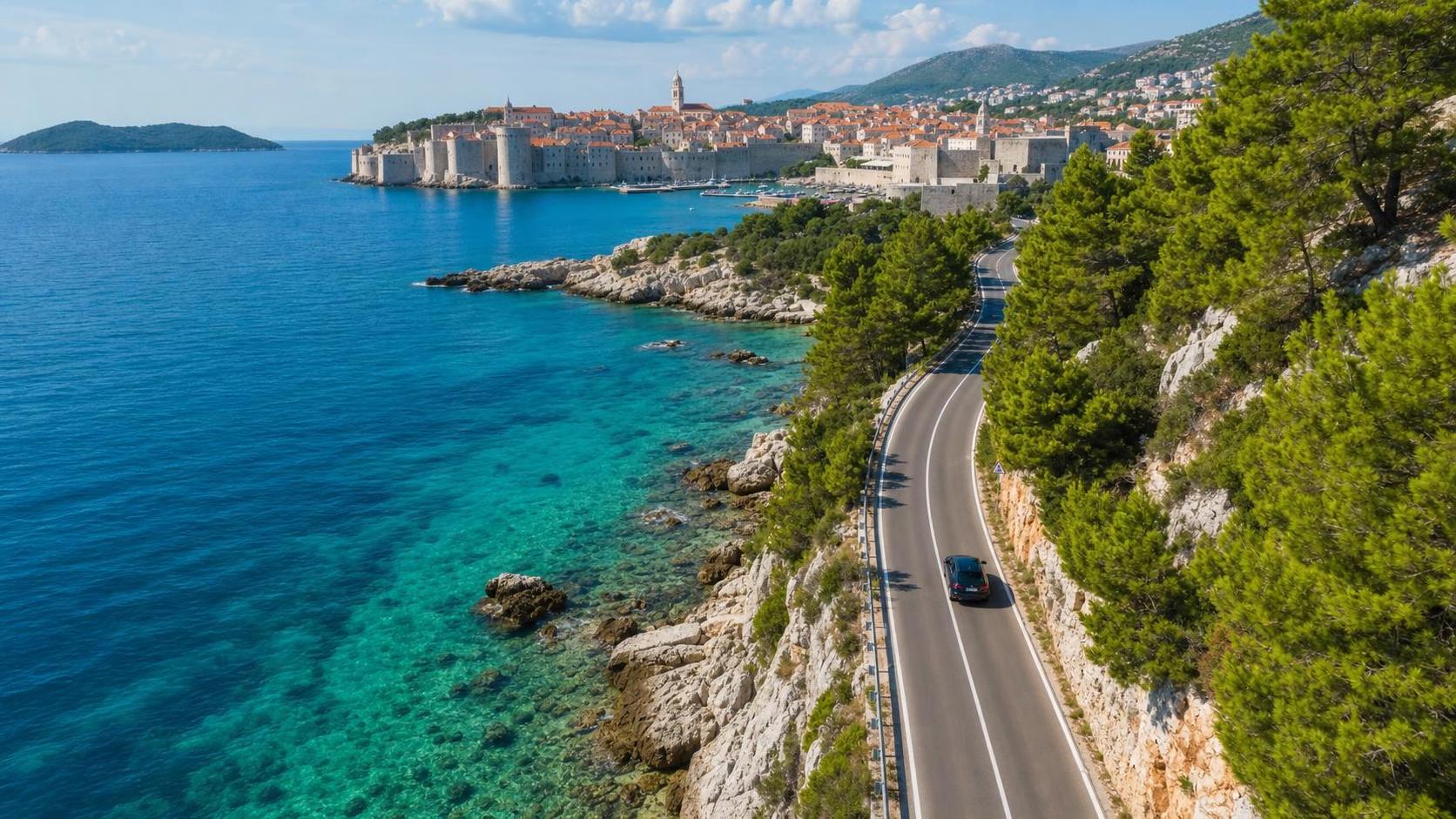
Coastal roads like the D8 (the old coastal road) are slower, windier, and far prettier. Plan extra time. In summer, expect heavy traffic between Split and Dubrovnik, especially around Makarska and the Neum Corridor (the 20-kilometre strip of Bosnia that cuts through Croatia’s coastline).
Winter driving in inland areas like Gorski Kotar or Lika may require snow chains. Check the weather forecast if you are heading north from Zagreb in December–February.
Crossing Borders
Many visitors want to drive from Croatia into Montenegro, Bosnia and Herzegovina, or Slovenia. Most rental agreements allow this, but you must request a green card (international insurance certificate) in advance. Some companies charge a cross-border fee of €20–€50.
The Neum Corridor is a special case. If you drive from Split to Dubrovnik via the coastal road, you pass through a small strip of Bosnia. A sticker or vignette is not required for transit, but keep your passport handy for occasional checks.
Ferry Rules
Taking a rental car to islands like Hvar, Brač, or Korčula is allowed by most suppliers, but you must inform them in advance. Ferry reservations are essential in July and August — show up without a booking and you will queue for hours. Jadrolinija is the main operator. Buy tickets online or at the port office.
Ferry costs vary by route and season. A typical car + driver crossing from Split to Brač is €20–€30 in summer. The driver pays; passengers travel free or at a small fee.
Best Routes for First-Timers
If this is your first Croatian road trip, these routes are manageable and spectacular:
- Zagreb to Plitvice Lakes — 2 hours on the A1, then a short rural drive. Perfect for a day trip.
- Split to Trogir — 30 minutes. A gentle introduction to coastal driving.
- Split to Makarska — 1.5 hours along the D8. Stunning views of Brač and Hvar across the water.
- Dubrovnik to Montenegro — 1 hour to the border at Debeli Brijeg. The Bay of Kotor is worth the paperwork.
- Pula to Rovinj — 45 minutes through Istrian wine country.
Related Destinations
Looking for more Croatian road trip inspiration? Also explore our guides to all car hire locations in Croatia, driving tips for Croatia, and cross-border travel rules.
For specific pickup points, check out Split Airport car hire, Zadar Airport car hire, and Rijeka Airport car hire — all with competitive rates and no hidden fees.
Ready to book? Visit our homepage for the best hire car deals.