
Rijeka to Pula Coastal Drive: Route, Tolls and Scenic Stops in Istria
Rijeka to Pula Coastal Drive: Route, Tolls and Scenic Stops in Istria
The Rijeka to Pula Drive: A Coastal Route Through Western Istria
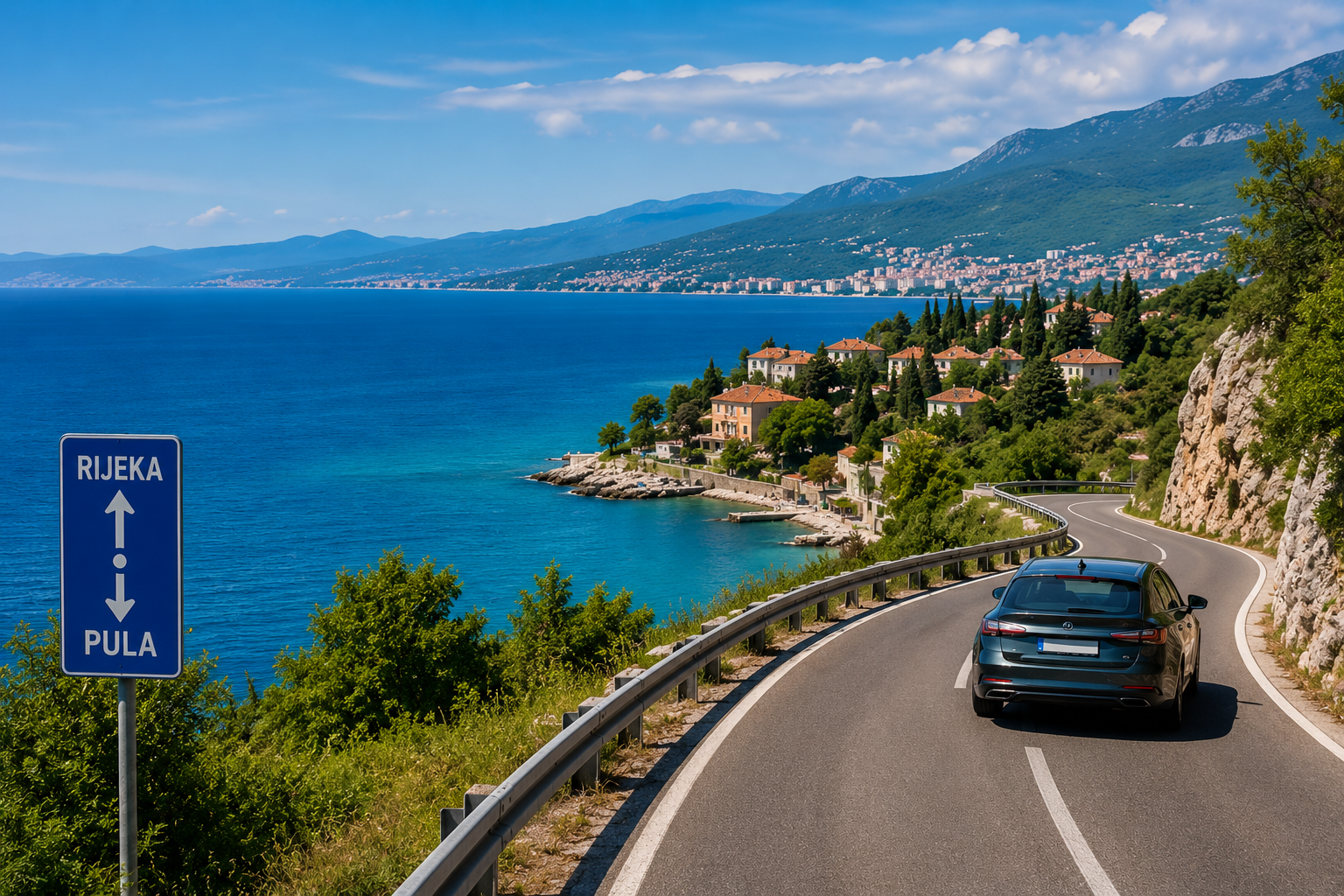
Pick up a car at Rijeka Airport and head south-west into Istria, and within minutes the Kvarner Bay gives way to vineyard-covered hills and ancient stone towns. The roughly 110 km coastal drive to Pula is one of Croatia’s most varied short road trips: you get Adriatic views, Roman ruins, hilltop villages and truffle country, all in under two hours of actual driving.
Most visitors to Croatia either base themselves in Rijeka or fly straight into Pula Airport. The gap between the two is often treated as a transfer rather than a journey. That is a mistake. The western Istrian coast rewards anyone who slows down.
Route Overview: Which Road to Take?
There are two realistic options between Rijeka and Pula. The faster route sticks to the E61 motorway south to Kanfanar, then cuts west on the A9 toward Pula. Total time is about 1 hour 30 minutes. The slower coastal route follows the old D8 and D66 roads along the western edge of the Istrian peninsula, adding roughly 30 to 45 minutes but giving you sea views, roadside konobas and the option to stop at multiple towns.
For a rental car, the motorway is cheaper on fuel and easier on suspension. The coastal route burns more fuel on winding roads but delivers the experience most visitors expect from an Istrian holiday. Our recommendation: take the motorway one way and the coast the other, or dip onto the coastal road for a single leg and use the A9 for the return.
Key Stops Along the Western Istrian Coast
Opatija (10 km from Rijeka)
Before you have even left the Kvarner region, Opatija offers a reason to pause. The Habsburg-era Lungomare promenade runs along the waterfront for 12 kilometres, and the town’s manicured gardens and belle époque villas make it feel closer to Vienna than Split. Parking in Opatija is metered along the waterfront and fills quickly in July and August. Use the paid garage near Slatina Beach rather than circling for street spots.
From Opatija, the coastal road continues to Lovran, then climbs inland toward the Učka mountain tunnel. The tunnel itself is short and well-lit, but the descent on the Istrian side drops you straight into vineyard country.
Buzet (65 km from Rijeka)
Billed as the “town of truffles,” Buzet sits on a hilltop above the Mirna River valley and is worth the short detour inland. The old town is compact: a walled core, a few cafes and viewpoints over green hills that look more like Tuscany than Dalmatia. The truffle season runs from September to January, but restaurants here serve truffle-infused dishes year-round. Parking is limited to a small lot below the old town gate.
Grožnjan and Motovun (70 to 80 km from Rijeka)
Both Grožnjan and Motovun sit on hilltops within 15 minutes of each other, and both require leaving the main road. Grožnjan is the smaller of the two: a medieval settlement with fewer than 200 residents, narrow cobblestones and a reputation for summer music festivals. Motovun is larger and more visited, with a well-preserved town wall and views across the Mirna valley. The road up to Motovun is steep and tight; a compact or mid-size rental car is fine, but avoid bringing a large SUV unless you are comfortable with Croatian mountain roads.
Between the two villages, you pass through truffle-and-wine country. If you are driving in autumn, roadside stalls sell fresh white truffles by weight.
Rovinj (95 km from Rijeka)
Rovinj is the visual highlight of the drive. The old town rises from a peninsula in the Adriatic, its church steeple visible from kilometres away. Unlike Dubrovnik, Rovinj is still approachable: you can park at the Mašlinica or Valdibora lots and walk into the old core in five minutes.
The waterfront cafés along the Riva are priced for tourists, but the side streets hide smaller konobas that locals still use. If you have time, walk up to the St. Euphemia church tower for a panoramic view of the archipelago. The tower climb costs a small fee and the stairs are narrow, but the view justifies it.
For those continuing south, Rovinj to Pula is a short 35 km hop along the D303. You can also extend your trip west to the Rovinj car hire page for more local driving tips.
Tolls and Driving Costs on the A9 Motorway
The A9 motorway runs north-south through central Istria and is the fastest way to cover distance. Tolls are reasonable: expect roughly €4 to €6 for the Rijeka-to-Pula stretch depending on your entry and exit points. You do not need a vignette for Croatian motorways; tolls are collected at toll booths by cash, card or contactless payment.
Fuel stations are available at most major junctions along the A9. If you are returning a rental car to Pula Airport, note that the airport has limited fuel options nearby. Fill up at one of the INA or Petrol stations along the A9 before you get close to the terminal.
Parking in Pula and at Key Stops
Pula’s old town is built around a Roman amphitheatre and has a well-organised parking zone system. Street parking in the centre is Zone 1, charged at roughly €1.50 per hour during the season. The large parking lot near the amphitheatre accepts both cash and card and is the most practical option for a quick visit.
Smaller stops like Buzet and Motovun have free or low-cost parking at the base of the hill. In Grožnjan, park at the entrance to the old town and walk the rest; the streets inside are pedestrian-only.
Best Time to Drive the Rijeka to Pula Route
Spring (April to June) and autumn (September to October) are ideal. The roads are quieter, the truffle and wine harvests are active, and the light across Istria’s rolling hills is at its best. July and August are drivable but expect heavy traffic around Rovinj and Pula, particularly on weekends when Italian and Slovenian visitors cross the border.
Winter driving is straightforward: the A9 is kept clear, and snow is rare below 300 metres. However, some coastal konobas and smaller guesthouses close from November to March, so restaurant options narrow outside the main towns.
Practical Tips for Car Hire Visitors
- Pick up at Rijeka Airport if you are flying in; the rental desks are in the terminal.
- Drop-off at Pula Airport is possible with most suppliers, but confirm one-way fees before booking.
- The D66 coastal road has several unlit tunnels between Opatija and Rovinj. Switch on headlights even in daytime; it is legally required.
- Road signs are in Croatian and Italian in Istria. Most locals in tourist areas speak English, but a few words of Italian go further than you might expect near the border.
- If you want a longer loop, drive from Rijeka to Pula via the coast, then return inland through Zagreb or Zadar.
Related Destinations
Looking for more Istrian road trips? Also explore Pula to Rovinj by Car, Istria Wine Road Trip, and Zagreb to Dubrovnik Drive for a longer cross-country route.
Ready to book? Visit our homepage for the best hire car deals.